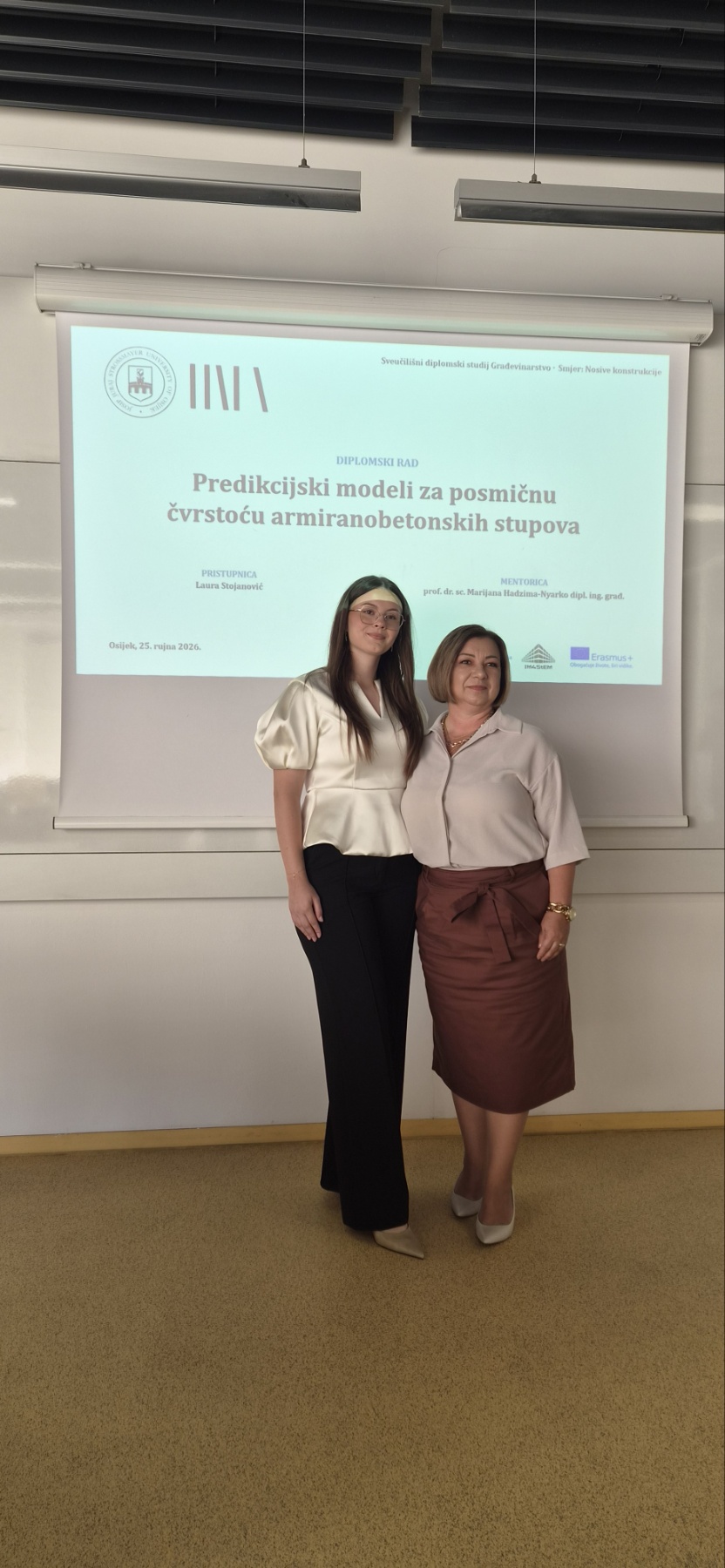
Thesis title: “Prediction models for the shear strength of reinforced concrete columns”
Student: Laura Stojanović
Supervisor: Prof. Marijana Hadzima-Nyarko, PhD
Study programme: University graduate study programme in Civil Engineering, Faculty of Civil Engineering and Architecture Osijek
Date of defence: 25 September 2026
Permanent link: https://urn.nsk.hr/urn:nbn:hr:133:290935
Within the Erasmus+ project IM4StEM – Intelligent Methods for Structures, Elements and Materials, the master’s thesis of student Laura Stojanović, entitled “Prediction models for the shear strength of reinforced concrete columns”, was successfully defended at the Faculty of Civil Engineering and Architecture Osijek on 25 September 2026. The thesis was supervised by Prof. Marijana Hadzima-Nyarko, PhD.
Reinforced concrete columns are crucial for the stability and seismic safety of buildings. Since shear failure of a column occurs suddenly and without warning, reliable prediction of shear strength and failure mode is one of the fundamental tasks of modern seismic design. Existing design codes and empirical equations often deviate considerably from experimental results because they do not fully capture the nonlinear interactions among geometric, material, and loading parameters.
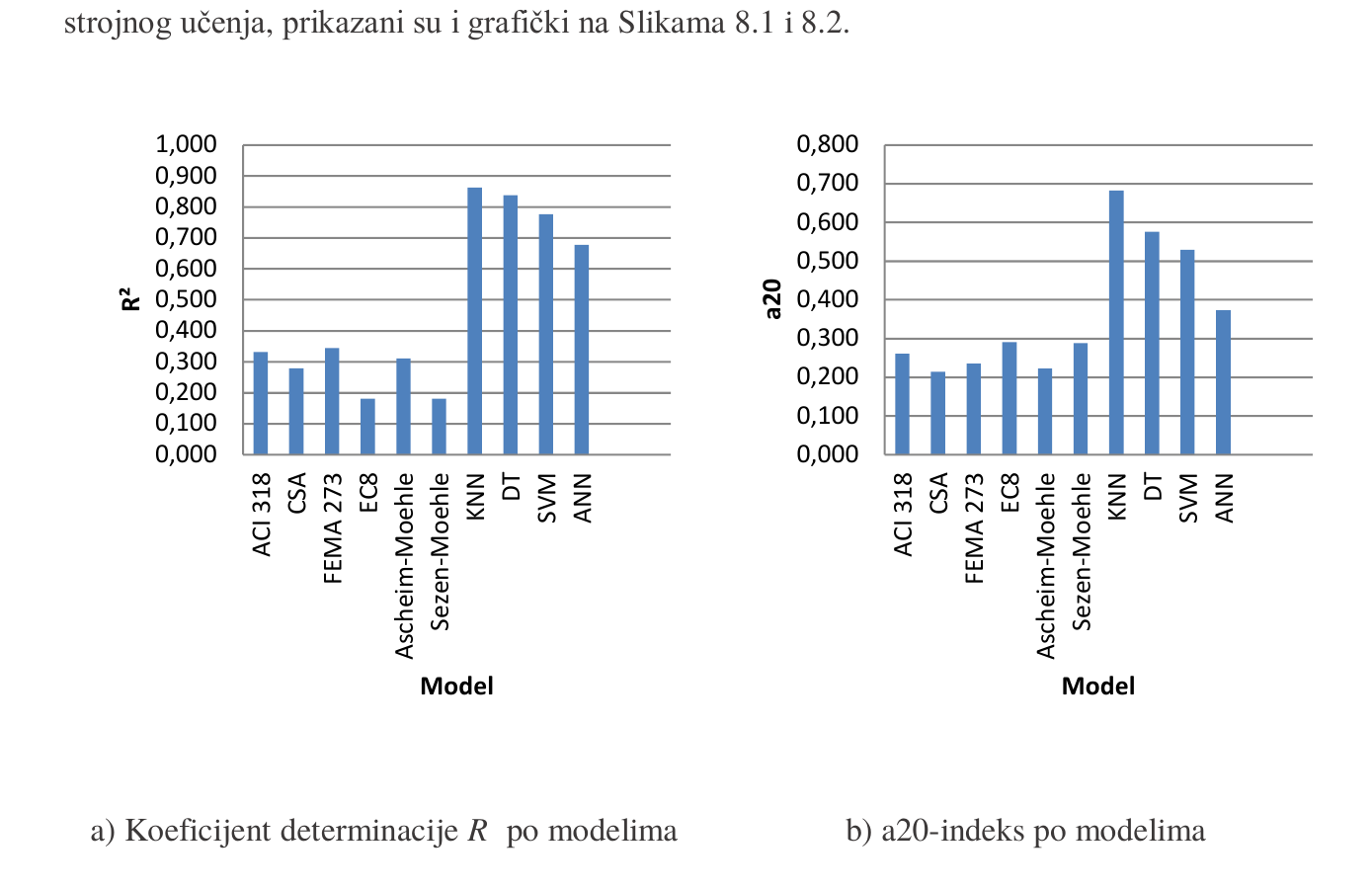
The thesis reviews and compares code-based equations (ACI 318, CSA, FEMA 273, Eurocode 8 and the models of Aschheim and Moehle and of Sezen and Moehle) with machine learning models for predicting the shear strength of rectangular reinforced concrete columns. The analysis draws on the study by Phan et al. (2022), in which five regression models were developed on a database of 541 experimental specimens: Multivariate Adaptive Regression Splines (MARS), Decision Tree (DT), K-Nearest Neighbours (KNN), Support Vector Machine (SVM) and Artificial Neural Network (ANN). Fisher discriminant analysis for failure mode classification and the Monte Carlo method for probabilistic seismic risk assessment are also considered.
As an independent contribution, a unified database of 785 experimentally tested rectangular reinforced concrete columns was compiled by merging two independent sources and removing duplicate records, and an independent comparison of code equations and machine learning models was carried out on it. The results show that machine learning models clearly outperform empirical equations: while code equations reach a coefficient of determination of at most R² = 0.627 (Eurocode 8), machine learning models exceed 0.86 on the unified database as well, with the ANN (R² = 0.938 on the test set) and KNN models achieving the best accuracy. Practical applicability is demonstrated through a graphical user interface in MATLAB, which enables rapid prediction of shear strength and failure mode using 10 input parameters.
The thesis was prepared within the IM4StEM project “Synergy of the application of intelligent methods in assessing the behaviour of buildings, elements and materials and innovative use of recycled building materials based on experimental and novel approaches for establishing a sustainable living space” (2023-1-HR01-KA220-HED-000165929), implemented under the Erasmus+ programme, with a particular focus on the application of intelligent methods in assessing the behaviour of structural elements. In line with the project’s objectives, the thesis contributes to the development of more reliable methods for assessing the seismic behaviour and safety of reinforced concrete structures.