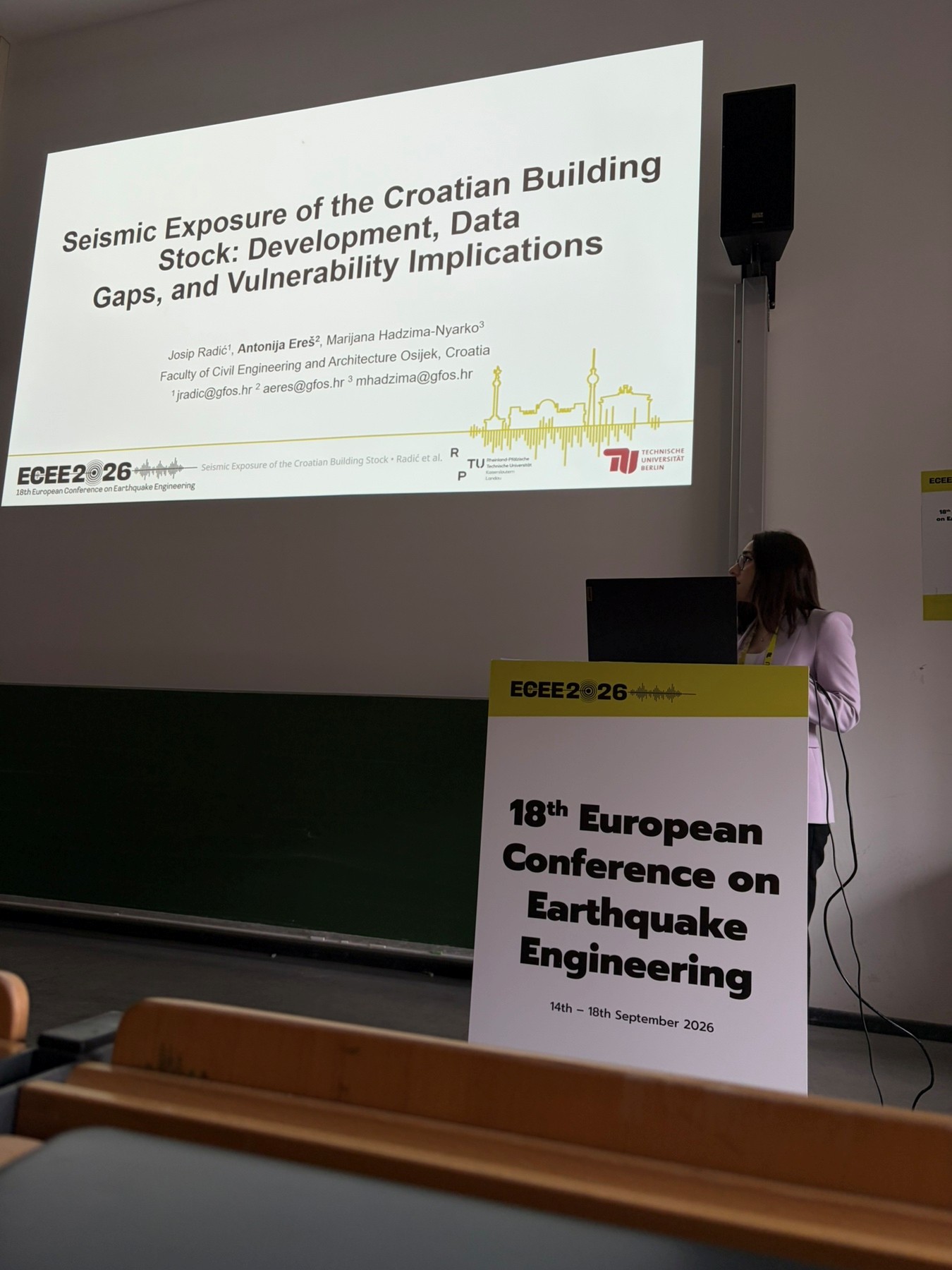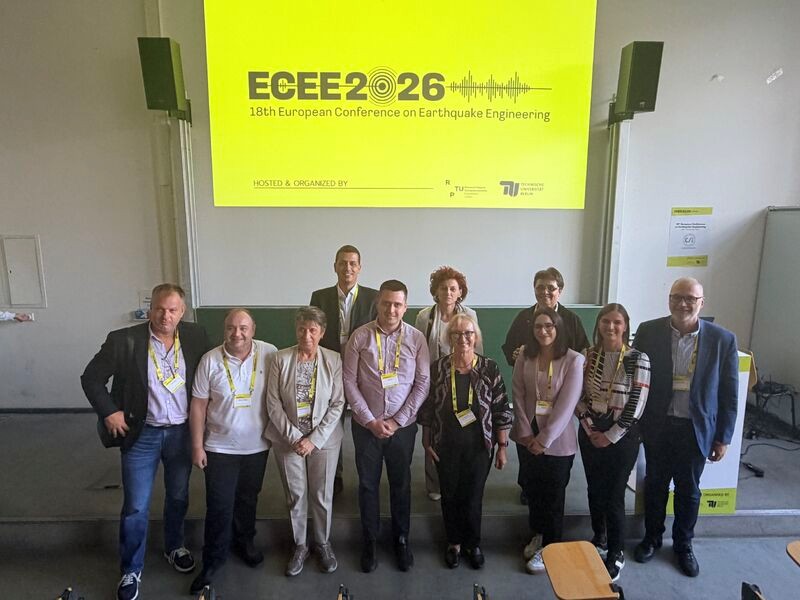
As part of the 18th European Conference on Earthquake Engineering (ECEE 2026), held in Berlin, Germany, researchers from the Faculty of Civil Engineering and Architecture Osijek presented the scientific paper “Seismic Exposure of the Croatian Building Stock: Development, Data Gaps, and Vulnerability Implications.” The paper, authored by Josip Radić, Antonija Ereš, and Marijana Hadzima-Nyarko, presents research conducted within the IM4StEM project and was presented during the Special Session “Seismic Exposure of the West Balkans Built Environment.”
The presentation focused on some of the main challenges in assessing seismic risk in Croatia, particularly the lack of detailed information about existing buildings and their structural characteristics. The study reviewed how Croatia’s building stock has developed over time, considering changes in construction methods, materials, and seismic design regulations. Special attention was given to older buildings constructed before modern seismic design requirements were introduced, as many of these structures may be particularly vulnerable to earthquakes.
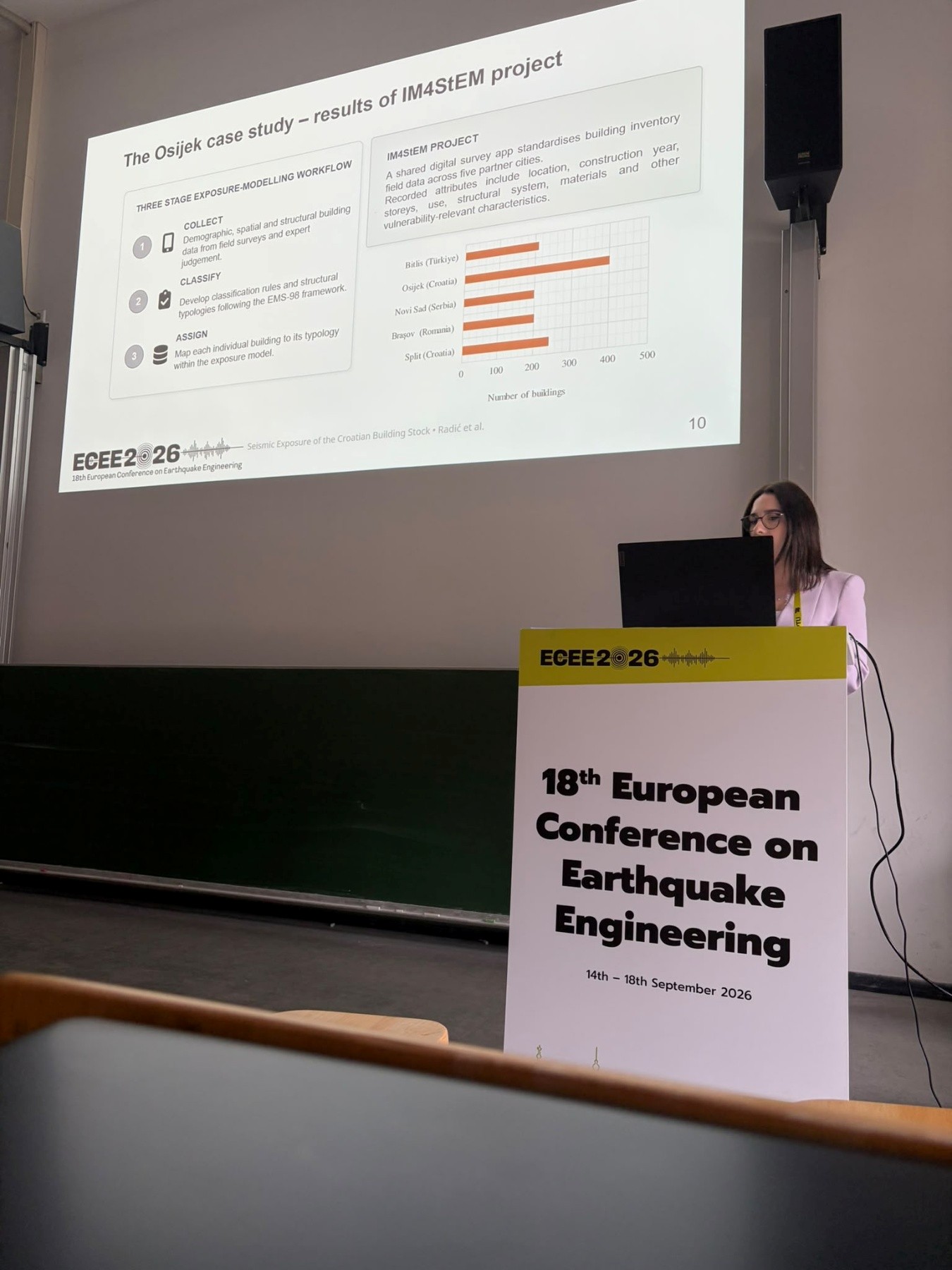
The City of Osijek was presented as a case study to show how collecting detailed information about individual buildings can improve understanding of seismic vulnerability. The presentation also introduced activities carried out within the IM4StEM project, including the development of a centralised building database and a digital application designed to support field surveys. These tools have been used to collect information regarding buildings in five partner cities: Osijek, Split, Brașov, Bitlis, and Novi Sad. The results from Osijek showed that traditional masonry buildings make up a large part of the surveyed building stock, with unreinforced masonry structures and flexible floor systems being particularly common. The results point to the importance of comprehending the structural characteristics of existing buildings when assessing their potential behaviour during earthquakes.
The research pointed out the need for more detailed and reliable building databases to improve seismic vulnerability assessments and support better earthquake risk management. Beyond presenting the research findings, participation in ECEE 2026 was also an important opportunity to share the IM4StEM project results with the international earthquake engineering community, exchange ideas with researchers working on related challenges, and consider opportunities for future collaboration.